
What Is Blackwork?
Blackwork is a broad family of tattoo styles built mainly, or entirely, from black ink. Instead of colour or soft grey gradients, it relies on solid black areas, strong lines, patterns and negative space (the bare skin left between the ink). The result is graphic, confident and very readable from a distance.
Blackwork has deep roots. Many of the oldest tattoo traditions in the world, from Polynesia to Borneo, are essentially blackwork. Today it covers everything from heavy tribal-inspired sleeves to fine ornamental patterns and modern illustrative designs.
Types of Blackwork We Tattoo
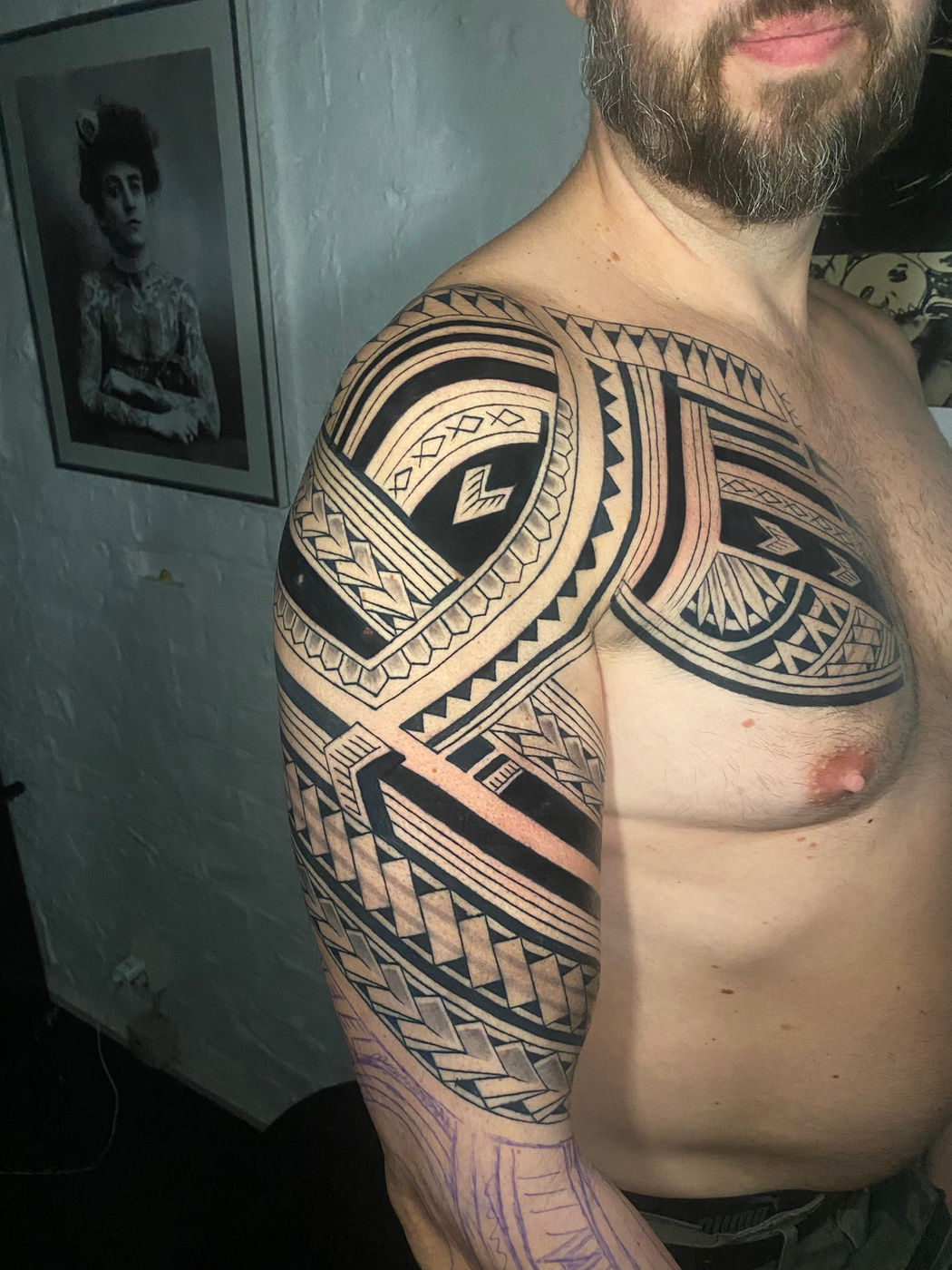
Tribal and Polynesian-inspired blackwork
Flowing black shapes that follow the muscles of the arm, shoulder and chest. Björn has a particular passion for Māori and Polynesian tattoos, which are among the most powerful forms of blackwork.
Ornamental and mandala work
Symmetrical patterns, lace-like details and mandalas, often placed on the back, sternum, thigh or elbow. Ornamental blackwork overlaps with sacred geometry.
Illustrative blackwork
Animals, skulls, plants and symbols drawn with strong black line work and solid fills, somewhere between an etching and a woodcut.
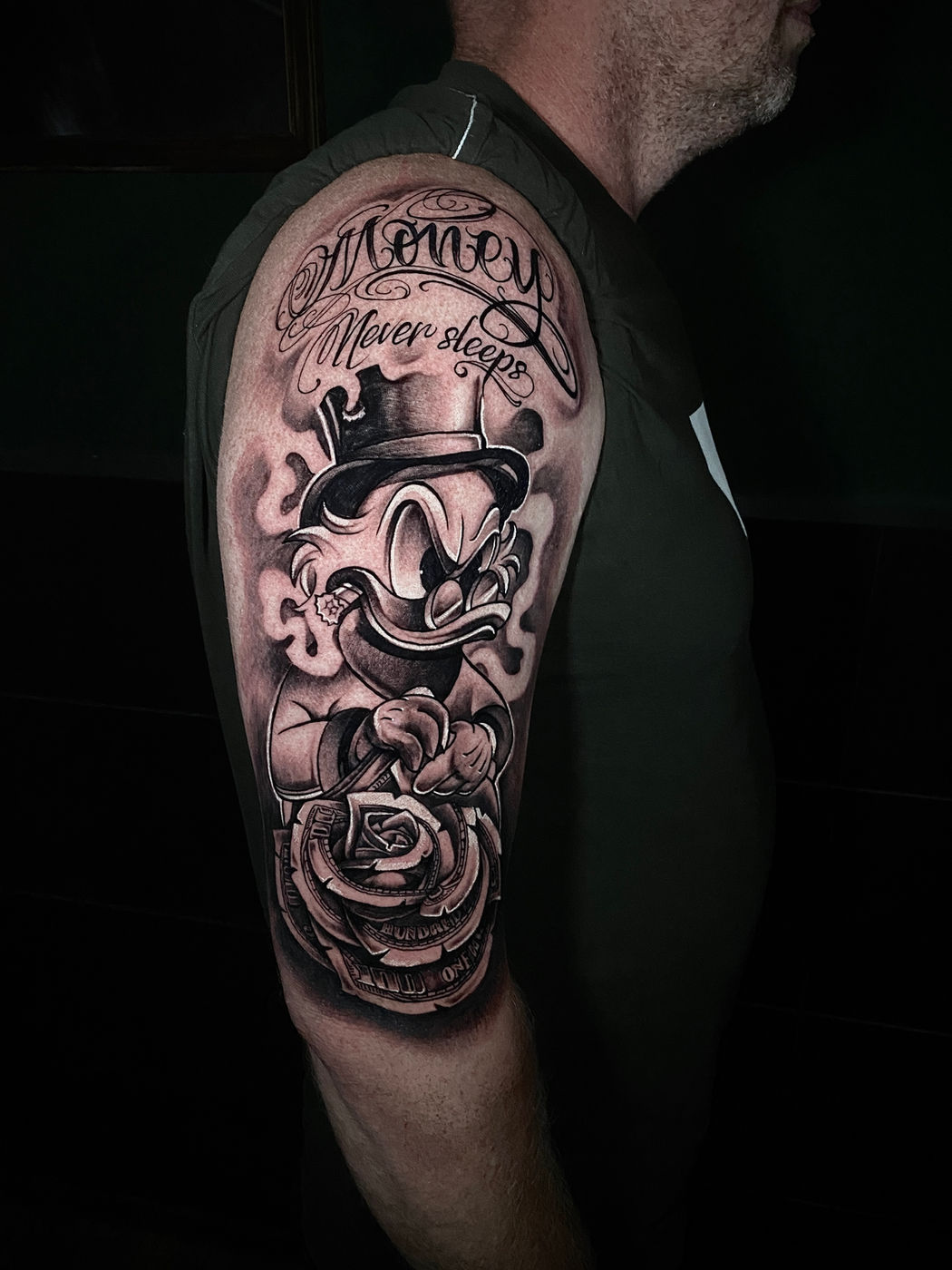
Black & grey shading
Where blackwork meets realism: solid black areas combined with soft grey shading for depth.
Why People Choose Blackwork
- It ages extremely well. Solid black is the most stable ink there is. Blackwork keeps its contrast for decades, even in a sunny climate like the Costa del Sol.
- It works on every skin tone. Black ink shows clearly on all skin types.
- It's ideal for large pieces. Sleeves, chest pieces and back pieces in blackwork have enormous visual impact.
- It can cover old tattoos. Solid black is one of the most reliable ways to cover an unwanted tattoo.
Designing Blackwork That Flows with Your Body
Good blackwork isn't a flat pattern stuck onto skin. It follows the shape of the body: the curve of the shoulder, the line of the forearm, the twist of the calf. That's why every blackwork piece at Oxygen Ink is drawn for the person wearing it. For larger work, Björn often sketches directly onto the skin so the design sits perfectly on the muscle.
Planning a Blackwork Sleeve or Back Piece
| Project | What to expect |
|---|---|
| Half sleeve | Usually several sessions. The design is planned as one composition from shoulder to elbow (or elbow to wrist). |
| Full sleeve | A longer project spread over multiple sessions, with healing time in between. |
| Chest or shoulder piece | Often combined with a sleeve so the design flows across the shoulder. |
| Back piece | The largest canvas on the body; perfect for symmetrical ornamental or tribal work. |
Big projects need planning, especially if you live outside Spain. If you visit the Costa del Sol regularly, many clients build a sleeve over several trips. Tell us your travel plans and we'll map it out.
Does Blackwork Hurt More?
Solid black areas take longer to fill than outlines, so sessions can feel more intense in sensitive spots like the ribs, inner arm or elbow. On the outer arm, shoulder and calf most people find it very manageable. Eat well before your session, stay hydrated and tell us if you need a break; we work at your pace.
Where Our Blackwork Tattoo Clients Come From
Our studio is on Avenida de España in Calahonda, right on the coast road between Marbella and Fuengirola, so it is an easy drive from most of the western Costa del Sol. Clients regularly come to us from:
- Marbella – about 20 minutes by car
- Fuengirola – about 15–20 minutes by car
- Calahonda – right here in Calahonda
- Riviera del Sol – about 5 minutes by car
- La Cala de Mijas – about 10 minutes by car
See all the areas we serve or browse our other tattoo styles.